
Missed Calls for Tour Operators: A Utah Outfitter Plan
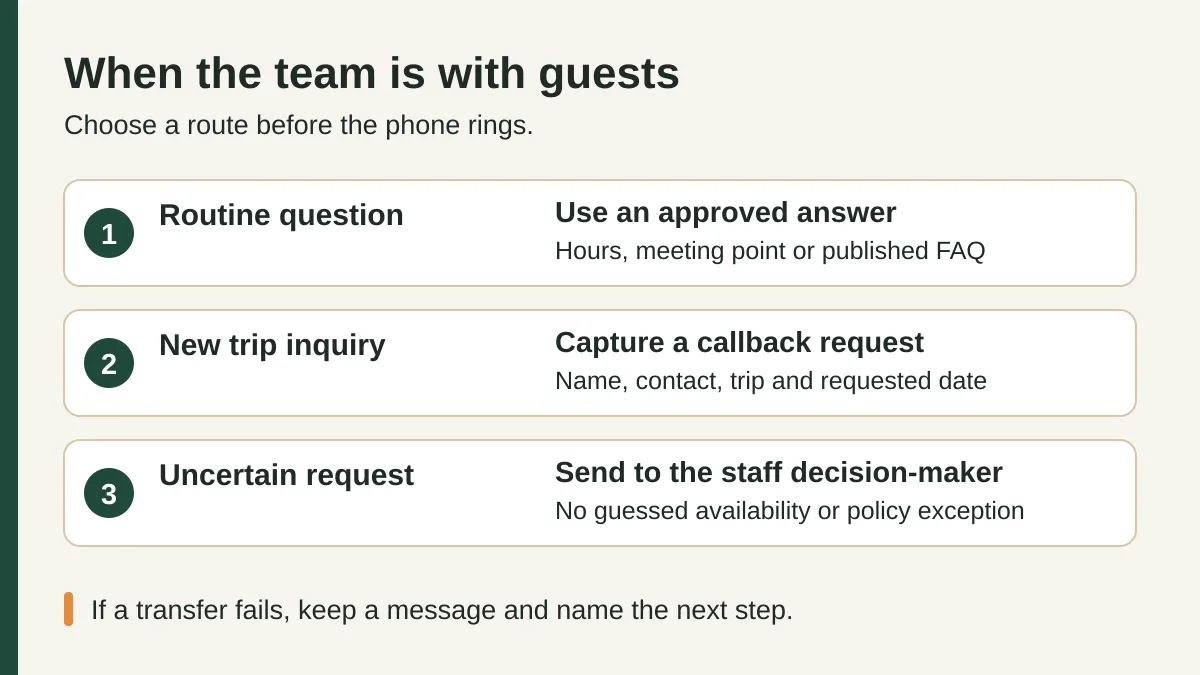
Missed calls for tour operators need a clear route while staff are with guests: answer approved routine questions, capture new inquiries, and send uncertain requests to a person. For Utah outfitters and guides, the first step is to choose who covers the phone during departures and trips. Give callers a callback window that matches actual staff coverage.
How do you handle missed calls for tour operators?
Use one overflow plan for the periods when your team cannot answer. An overflow plan tells whoever handles the call what they can answer, what details to collect, and where to send a request that needs judgment. It also says what happens if nobody accepts a transfer.
Write a one-page routing card before changing phone tools:
- Coverage: which departures, check-ins or field periods need another answering route.
- Approved answers: current hours, meeting points, booking links and published policies, with a staff member responsible for keeping them current.
- Inquiry details: caller name, callback contact, requested trip or rental, date and the question staff need to answer.
- Handoff: a named duty contact and backup for requests outside the approved answers.
- Fallback: where a message goes and the staffed callback window the caller hears if a transfer fails.
Keep this card where both front-desk staff and any answering provider can use it. Change it when seasonal hours or departure locations change, not after an old answer causes confusion.
Choose the coverage that fits the call
| Option | Works well when | What you still need to manage |
|---|---|---|
| Rotating staff phone coverage | A staff member can cover the desk without interrupting guest service | A shift schedule and backup when that person is occupied |
| Voicemail with a clear greeting | Calls can wait until the next staffed review | A real review time, named owner and callback process |
| Online booking and FAQs | Callers have standard questions or can book through your existing system | Accurate policies and a route for exceptions |
| An answering service | Someone needs to receive inquiries while the team is unavailable | Approved answers, intake limits, transfers and failure handling |
These options can work together. Your booking site can handle a standard reservation while a person handles a custom group request. A useful FAQ can answer what to bring without pulling a guide away from guests.
Western River Expeditions' contact page publishes office hours and tells inquiry-form users to expect a reply the next business day. That's a useful example of making the response expectation visible. It is not evidence of missed calls or a customer relationship with our agency.
Work through a departure-day example
Consider a fictional Moab guiding business. Its front desk is occupied from 8:00 to 9:00 a.m. with a departure. Morgan covers the inquiry queue at 9:30, and Lee is the backup if Morgan is still helping guests.
- A caller asks where to meet. The answering route uses the meeting point approved for that specific trip, rather than a generic address.
- Another caller asks for four places tomorrow. The route collects the trip, date, party size and callback number. Staff check availability before making a commitment.
- A caller requests an exception to the group's booking terms. The request goes to the duty manager; the answering route does not invent a policy.
- Morgan receives the queue at 9:30. If Morgan cannot take it, Lee accepts responsibility rather than assuming someone else saw the messages.
Before your departure shift, use the printable callback handover sheet to agree the responsible staff role, backup and review times for this queue. The sheet establishes shift ownership; keep caller records and bookings in your existing staff-only system, not on the sheet.
For a voicemail fallback, a greeting could say:
“Our team is helping guests right now. Please leave your name, callback number, requested trip and date. Today's desk team will return inquiry calls between 9:30 and 10:30 a.m. Mountain Time. For standard bookings and trip details, use the booking page and FAQs on our website.”
Use that window only if your staff can meet it. An unattended inbox with a friendly greeting is still unattended.
Test the failure paths before a busy day
Place test calls for a routine question, a new inquiry and a request outside the script. Then test a failed transfer. Check that the message reaches the right queue, includes a usable callback contact and leaves the caller with a clear next step.
Also check that an old meeting point cannot override the current trip information. If you lack an approved answer, the route should ask staff instead of filling the gap. Requests involving safety judgment belong with qualified staff under your established procedures, not an improvised phone answer.
Before the next departure, trace one test call from the unanswered phone to the person who will act on it. If the route ends at “staff check later,” add the owner and backup to your routing card. The “current missed-call path” in our fictional Utah rental-shop sample audit shows where that missing step belongs, followed by manual changes to try before automation.
To review your own departure-day coverage, Request a Free Missed-Call Revenue Audit. Growth Ops Agency reviews the process you describe and recommends practical changes; the audit does not access call records or calculate recovered revenue.