
After-Hours Booking Inquiries: A Utah Rental Plan
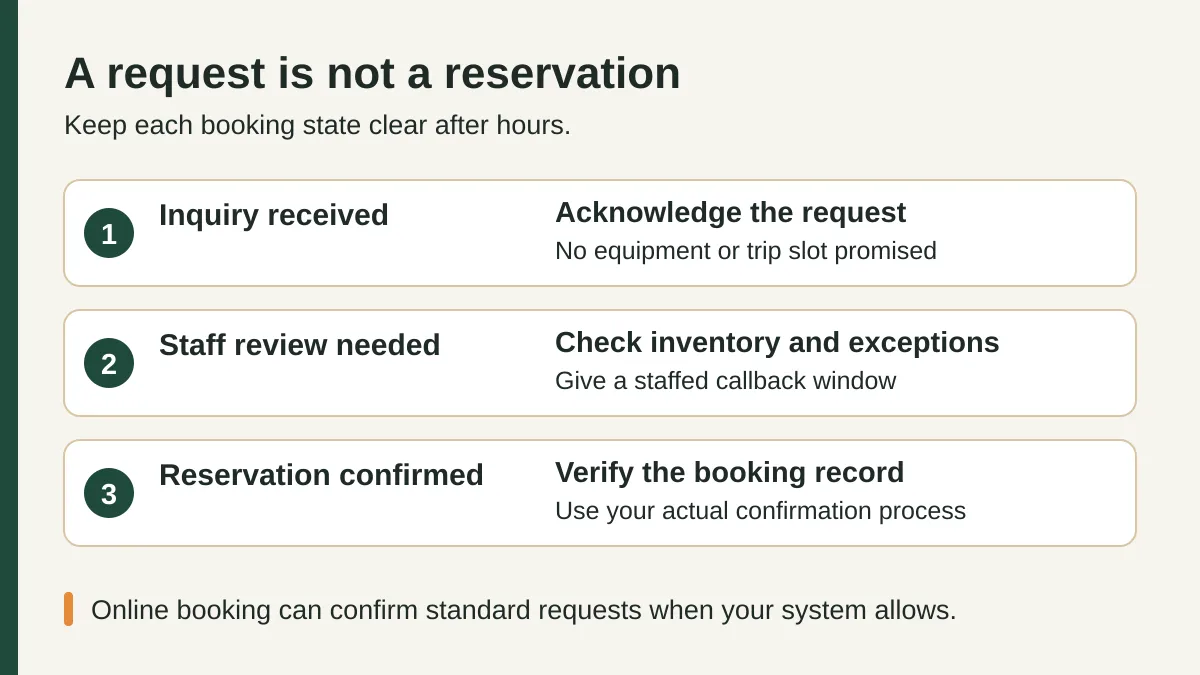
After-hours booking inquiries should receive useful approved information and a clear next step, not a promise of an unconfirmed rental or trip. Let your existing online booking system handle standard reservations when it can verify them. Send late pickups, special arrangements and uncertain availability to staff, with a callback expectation that matches the next staffed period.
What can you say during after-hours booking inquiries?
Answer facts your team has approved: published hours, the normal pickup process, where to find trip details and how to use your booking page. Treat availability, exceptions and changes to existing reservations as separate decisions. A message received is an inquiry; it becomes a confirmed reservation only through your actual confirmation process.
Use three labels in the handoff record:
- Inquiry received: the caller has asked for equipment, a trip or a change. Nothing has been allocated yet.
- Staff review needed: someone must check inventory, staffing, pickup arrangements or a policy exception.
- Reservation confirmed: your booking system or authorized staff has completed the business's confirmation process.
Don't move a request into the third state simply because the caller gave a date and contact number.
Give each request a useful route
| After-hours request | Useful response | What needs confirmation |
|---|---|---|
| “What time do you open?” | Give the approved hours for that location and date | Holiday or seasonal hours if missing from the approved information |
| “Can I rent two bikes tomorrow?” | Share the standard booking link, or capture the requested date and equipment | Actual inventory and any nonstandard requirements |
| “Can I collect the rental tonight?” | Explain the published pickup policy and record the requested time | Staff access and explicit approval of a late pickup |
| “Can you change my trip?” | Capture the existing booking reference and requested change through the agreed process | Whether the change is possible and any applicable terms |
| “Can our group do a different itinerary?” | Record the request for the trip decision-maker | Suitability, staffing and the custom arrangement |
A published price can be shared from your approved rate information. A special quote, discount or refund decision needs the person authorized to give it.
Keep online booking and FAQs in the plan
A functioning booking page is often the best route for a standard request. If it checks inventory and issues confirmation, callers can use it without waiting for a desk callback. Keep a separate route for questions that the system cannot resolve.
Read your own booking page carefully: does it accept a request, hold inventory or confirm a reservation? Those actions are different. For a Utah example, Wasatch Fly Fisher's FAQ says customers choose a date and send a request, then the guide confirms by phone or email. The page also says nothing is charged online. That illustrates why a calendar request should not automatically be described as a booking; the operator is not an agency customer example.
FAQs can cover preparation and normal rental terms. Give approved information its own review owner so the phone answer and website don't disagree about seasonal hours or pickup rules.
Use a late-pickup script that leaves room for review
Consider a fictional rental shop in Hurricane. A caller at 8:40 p.m. asks for two bikes for the next morning, with collection that evening. The shop's approved information contains normal pickup hours but no late-pickup arrangement. Its next staffed callback window is 8:00–9:00 a.m. Mountain Time.
A useful response is:
“I can take your request for two bikes tomorrow. Tonight's pickup needs staff approval, so I can't confirm it. The desk will call between 8:00 and 9:00 a.m. Mountain Time to discuss availability and pickup. You can also check our online booking page for standard reservations.”
Collect the caller's name, callback number, requested equipment, rental dates and pickup request. Mark the record “staff review needed: late pickup,” rather than “two bikes booked.” Do not collect payment-card details in a general call note; use the shop's designated booking or payment process.
If the caller needs an answer before the next staffed window, explain that the current route cannot confirm the arrangement. Don't shorten the callback promise unless a staff member has actually agreed to cover it.
To decide whether after-hours callers can wait for a callback or need approved routine answers sooner, compare staff cover, improved voicemail, live answering and AI-supported answering.
Check what the caller heard, not just what was saved
Test a standard booking inquiry, an unavailable item, a late pickup and a booking change. Listen for words such as “reserved,” “all set” or “guaranteed” appearing before confirmation. Check that the record and caller response describe the same state.
For a request that needs a safety or suitability decision, capture the operational question and use the established staff escalation route. The answering process should not supply improvised safety advice.
If inquiries also arrive during departures, use the missed-call plan for Utah outfitters to choose daytime coverage.
Before closing tonight, compare your greeting with the pickup rules staff actually use. Keep standard instructions on the approved reference sheet and identify who can authorize an exception. Our fictional paddle-rental sample audit includes a replacement greeting and a counter-reference rule that leaves availability and late-return exceptions with staff.
If your after-hours message and booking process give different expectations, Request a Free Missed-Call Revenue Audit from Growth Ops Agency. The free review uses your description of the process, not call-record access or a recovered-revenue estimate; it does not activate booking support or confirm an appointment.