
Answering Service Pricing for Seasonal Businesses
Compare answering service pricing using the same coverage, billable workload and seasonal pattern—not the monthly fee alone. Ask each provider to calculate a quiet month and a peak month, including overages and separate charges. For a Utah rental shop or outfitter, also price what happens when you reduce coverage or close for the season.
How do you compare answering service pricing?
An answering-service quote is comparable only when you know what the provider counts and what work the fee covers. Minutes, calls and unique callers are different billing units. A plan that looks inexpensive for short pickup questions may cost more when callers need longer rental explanations.
Start by giving every provider the same scope: which hours to cover, which routine questions to answer, which requests to collect and which exceptions to send to staff. Ask them to separate answering a call from confirming a booking or reaching a person. Those are different tasks, even when they appear on the same feature list.
Before comparing quotes, use the call-handling comparison to decide whether staff cover, improved voicemail, live answering or AI-supported answering suits your seasonal calls.
Use this table to translate each quote before comparing totals:
| Billing unit | Workload to supply | Question to settle in writing |
|---|---|---|
| Minutes | Expected calls and billable duration per call | Are calls rounded up? Do hold, transfer or after-call work count? |
| Calls | Expected billable calls | Do repeat calls, spam, wrong numbers or short hang-ups count? |
| Unique customers | Expected distinct customers under the provider's definition | How are repeat calls and multiple phone numbers counted? |
| Flat fee or bundle | Expected usage and required actions | What limits, overages or restrictions apply? |
For a concrete published example, Goodcall's pricing page, checked on November 19, 2026, lists its Starter plan at $79 a month for 100 unique customers, then $0.79 for each additional unique customer. It lists an approximate call count separately. That is a provider-specific billing model, not a market average or a managed-service quote: don't compare its customer allowance directly with another provider's minute allowance.
Calculate a quiet month and a peak month
Use your own aggregate call counts where available. If you don't have them, label your estimates and ask for a sensitivity calculation at higher usage. You can discuss workload without sending customer names, phone numbers or recordings.
For a minute bundle, the basic calculation is:
Monthly usage cost = base fee + max(0, billable minutes − included minutes) × overage rate.
Then add any separately quoted fees and applicable taxes. Use the provider's billing increments to estimate minutes, rather than assuming conversation duration equals billable duration.
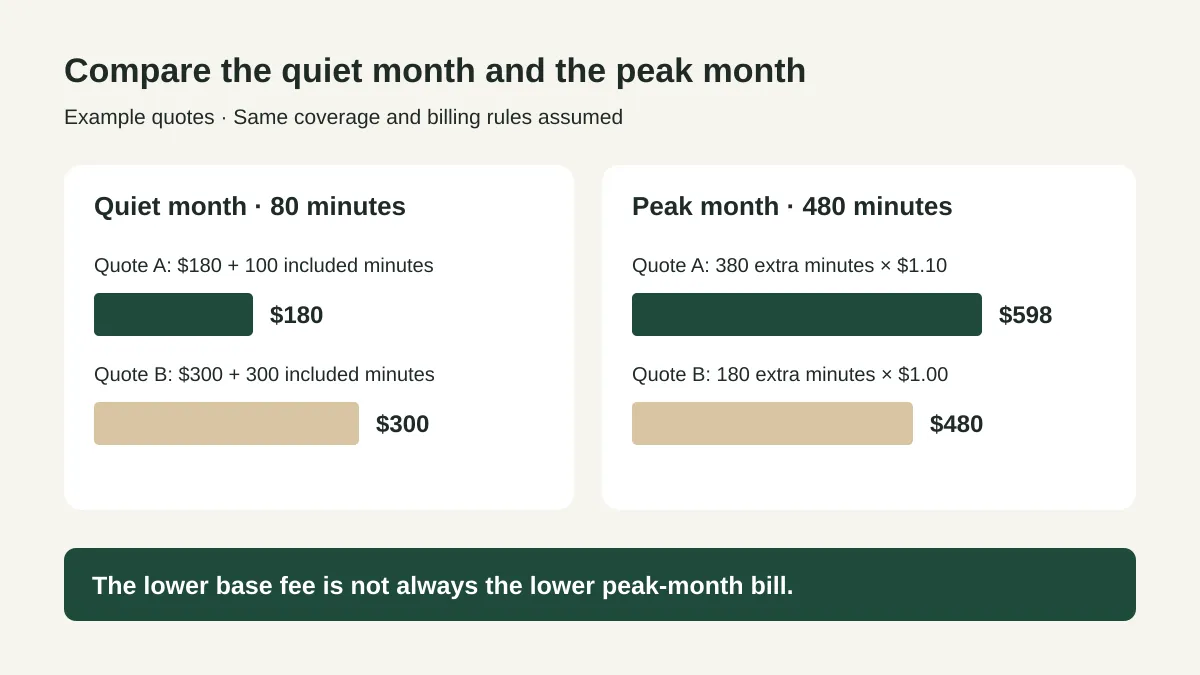
Consider a fictional Moab equipment-rental shop comparing two example quotes. Assume identical coverage and billable-minute rules, with no other charges in this calculation:
- Quote A: $180 a month, 100 minutes included, then $1.10 per extra minute.
- Quote B: $300 a month, 300 minutes included, then $1.00 per extra minute.
- Quiet month: 40 calls averaging 2 billable minutes, or 80 minutes.
- Peak month: 160 calls averaging 3 billable minutes, or 480 minutes.
| Month | Quote A | Quote B |
|---|---|---|
| Quiet: 80 minutes | $180; no overage | $300; no overage |
| Peak: 480 minutes | $180 + 380 × $1.10 = $598 | $300 + 180 × $1.00 = $480 |
Quote A costs $120 less in the quiet month. Quote B costs $118 less in the peak month. Neither is automatically the better seasonal choice.
If the shop has eight quiet months and four peak months, the example annual usage totals are $3,832 for A and $4,320 for B. A is cheaper over that year despite its higher peak bills. Add setup, other charges and the actual seasonal terms before deciding; permission to switch tiers could change the result.
Ask what a seasonal reduction actually changes
A lower off-season fee is useful only if you understand the coverage you keep and the cost of restoring it. Ask for answers to these questions in the proposal:
- Can we reduce the plan or pause service? What notice is required?
- Does a pause stop answering entirely, or leave a smaller coverage window?
- Are unused allowances lost, carried forward or pooled across months?
- Does restarting require a fee, new setup or a minimum commitment?
- Who updates seasonal hours, pickup instructions and staff destinations? Is that work included?
- Is billing by calendar month or another cycle? How many charges fall within the proposed term?
- What happens to our existing number and forwarding route when we leave?
Calculate the full term using those answers. Don't assume four months of use means four monthly payments if the agreement has a longer minimum term.
Separate coverage costs from the work staff still do
A quote can cover round-the-clock answering without providing round-the-clock staff callbacks. Ask who handles a request that arrives at 10 p.m., where the message goes and what the caller is told when nobody is available.
For a rental business, make the scope concrete: “Can you give our approved Saturday pickup hours, collect a request for two medium bikes, and leave uncertain availability for our team?” Then ask whether booking access, transfer attempts, notifications and ongoing answer updates are included or separately charged.
The fictional rental inquiry walkthrough shows the difference between an approved answer and a request needing staff review. Use those distinctions to describe the work you want priced; the walkthrough is a fixed example, not a live voice demo.
Also estimate the staff time left behind. A low monthly fee may still require someone to correct messages, update scripts or reconcile booking requests. Compare that effort alongside the invoice without assuming every answered inquiry becomes a sale.
Request a total-cost answer you can keep
Send the same short request to each provider:
Please quote our agreed coverage for both a quiet month and a peak month. Show the billing unit, included allowance, overage calculation, setup fee and any separate number, transfer, booking-tool or support charges. Include seasonal reduction, restart and cancellation terms, plus the work our staff will still own. Please state the assumptions behind both totals.
Choose the quote whose scope fits your calls and whose full-term cost you can explain. If a provider cannot explain what triggers an extra charge, resolve that before signing. Once the scope and price are clear, use the rental-shop receptionist testing guide to check whether the agreed call path actually works.
Growth Ops Agency's Free Missed-Call Revenue Audit reviews your described process and identifies practical next steps before you discuss a managed-service quote. Our pricing and scope page explains how the written proposal sets fees, responsibilities and tool dependencies; implementation follows agreement and testing.