
How to Test a 24/7 Virtual Receptionist for a Rental Shop
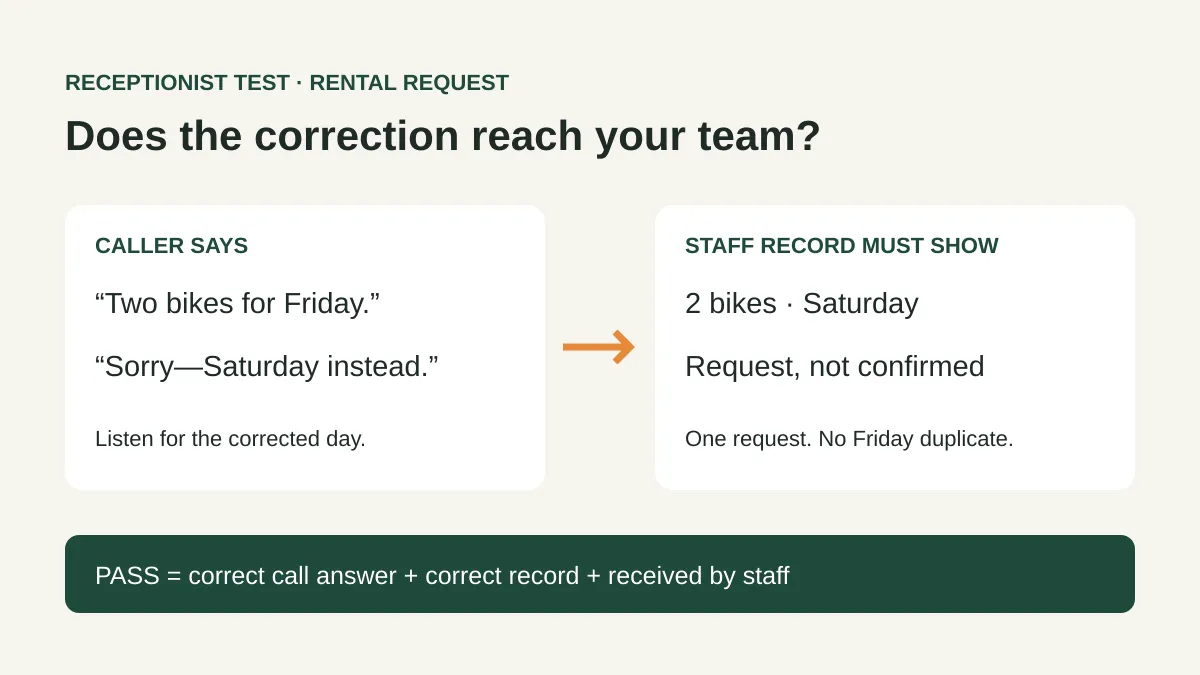
To test a 24/7 Virtual Receptionist, make real phone calls with planned rental scenarios, then compare what the caller heard with the record your staff received. Include corrected dates, uncertain equipment availability and a request outside the approved policies. Keep customer calls on your existing route until errors that could mislead callers or lose requests are fixed and retested.
How do you test a 24/7 Virtual Receptionist before launch?
Test the whole call path, not just the voice. A receptionist test passes when the answer is accurate, the saved request matches the caller's final instructions and the intended staff member can find it. A friendly conversation can still fail if it leaves the wrong rental date in the queue.
Use a separate test number or a provider-approved test route that customers won't reach. Ask someone who didn't write the instructions to make some of the calls. Text previews can help check wording, but they don't test speech recognition, interruptions or the actual phone transfer.
Sawy's pre-launch testing guide also recommends synthetic caller details and checking the phone call as well as the dashboard result. Its product-specific features aren't requirements for your setup; inspect the destinations and actions your own provider has agreed to support.
Write the expected result before you dial
Prepare a small set of approved business facts: location, seasonal hours, rental categories, pickup rules and the route for exceptions. Put a version date on that sheet. If the website and phone instructions disagree, resolve the conflict before testing.
Use invented names and rental requests, with a callback destination controlled by your team if you need to test delivery. Keep real customer records, payment details and sensitive information out of the test. Use recordings or transcripts only through your approved setup; otherwise, have a second tester take notes.
For each call, copy these fields into a staff-only test sheet:
- Test ID, date and business-information version.
- Exact question or correction the tester will use.
- Expected spoken answer and expected saved result.
- Actual answer, record destination and staff receipt.
- Pass or fail, the specific fault and the person assigned to fix it.
- Retest ID and outcome.
Don't score a call solely from memory. Open the actual message or request where staff will work on it.
Use these rental-shop test calls
These are suggested tests, not a certification standard. Adapt the equipment and policies to your shop, and use full calendar dates rather than just weekdays when checking the saved result.
| Test call | Pass only when |
|---|---|
| Ask for pickup hours on a date after your seasonal schedule changes | The answer uses the approved schedule for that date, not last season's hours |
| Request two bikes for Friday, then change to Saturday | The final request has Saturday, two bikes and no duplicate Friday request |
| Ask whether a specific bike size is definitely available | The answer uses verified availability if supported; otherwise it leaves an availability request for staff |
| Ask to return equipment at a different location | The approved policy is given, or the exception goes for review without a promise |
| Ask for a discount missing from the price sheet | No invented price or discount appears in the conversation or record |
| Ask for a person while the receiving staff member is available | The agreed handoff reaches that person, with enough context to continue |
| Repeat the request while the receiving line is unavailable | The agreed fallback works and the caller is told the next step |
| Correct a callback digit, then pause or interrupt | The final contact is correct; uncertainty prompts clarification rather than a guess |
| Ask which route is suitable for a rider beyond the approved information | The operational question reaches qualified staff without improvised suitability advice |
If booking is part of the agreed setup, add a controlled test for an unavailable slot and a changed request. Check the booking record for unintended holds or duplicates. A demonstration with one open slot doesn't prove the system handles conflicts.
Follow one corrected request through to staff receipt
Consider a fictional Park City bike-rental shop testing on Monday, November 16, 2026. The tester asks for two bikes on Friday, November 20, then says, “Sorry, I meant Saturday, November 21.” The setup collects requests; it doesn't confirm inventory.
The expected result is one request for two bikes on November 21, with availability still awaiting staff review. The closing answer should reflect that corrected date and avoid saying the bikes are reserved.
Suppose the caller hears Saturday correctly, but the staff summary still says Friday. Mark the call failed even if the transcript contains the correction. The team acts on the summary, so the error has survived into the working process.
Assign the fault to the person responsible for the instructions or request mapping. After the fix, repeat the call and try the reverse correction—from Saturday back to Friday. Then rerun the availability and booking tests that depend on those same fields. Keep the failed result beside the retest so the team can see what changed.
Set stop rules instead of averaging away serious errors
Treat an invented confirmation, wrong date, unusable callback contact or undelivered request as a launch blocker for the affected call path. A high average score on polite greetings doesn't cancel one of those failures.
Separate faults by where they occur:
- Wrong spoken fact: review the approved information and answer rules.
- Correct speech but wrong saved detail: inspect extraction or field mapping.
- Correct record but nobody receives it: inspect routing, access and notifications.
- Failed handoff with no next step: repair the fallback and test it from the caller's side.
Fix the cause, repeat the failed case, then rerun related cases. If an optional booking action cannot pass, remove it from the initial scope and test the request-only route instead. Don't leave the same action enabled with a vague warning to staff.
Start with a monitored window and a tested fallback
After internal tests pass, choose a limited coverage window that your team can monitor. Name who will inspect new requests and who can restore the previous phone route. Test that restoration before relying on it.
Review early calls through the approved review process and add new failure cases to the sheet. Repeat relevant tests when seasonal hours, pickup rules, equipment categories or staff destinations change. Keep coverage narrow until the observed results support expanding it; passing a test set doesn't guarantee every future call.
For the operational plan behind your tests, use the outfitter call-coverage guide. To decide what counts as a booking, see the after-hours inquiry and confirmation guide.
Review our 24/7 Virtual Receptionist setup explanation for how to agree approved answers, information upkeep and staff handoffs before implementation.
Growth Ops Agency's Free Missed-Call Revenue Audit reviews your described call process and identifies practical next steps. It's a human review, not automatic access to call records or an estimate of guaranteed recovered revenue.