
Customer Service Call Scripts for Rental Shops
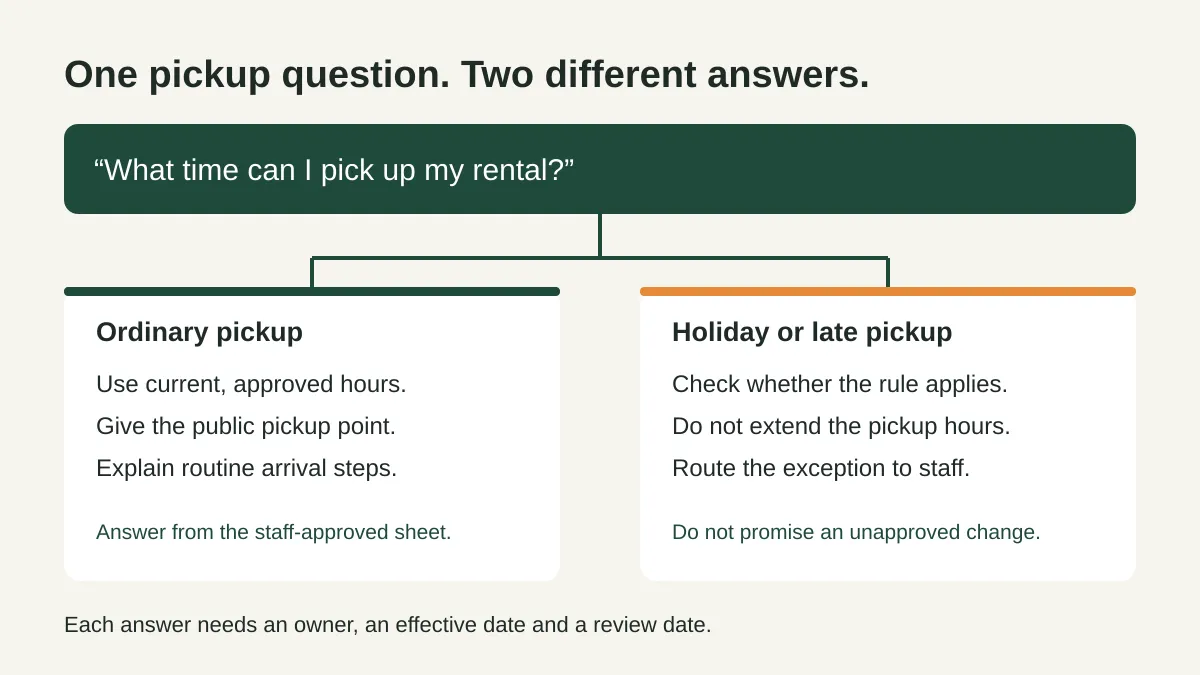
Customer service call scripts for rental shops should give callers accurate pickup hours, clear arrival steps and standard return instructions. Write each answer from your current operating rules, then add a line for requests that need staff approval. Keep a named owner and review date on the sheet so last season's answers don't reach this season's callers.
What should rental customer service call scripts include?
A customer service call script is prepared wording for a recurring phone question. For a rental shop, each script needs the question, the approved answer, when that answer applies and the next step when it doesn't. Start with three ordinary questions rather than trying to script every possible conversation.
| Caller asks | Facts to approve | Boundary to write beside the answer |
|---|---|---|
| “When can I pick up?” | Pickup days and hours, with the applicable season | Holiday hours and early or late pickup need their own approved rule |
| “Where do I go?” | Public pickup point and routine arrival steps | Alternate locations and special access arrangements go to staff |
| “How do I return it?” | Standard return point and check-in steps | Late returns, damage and disputed charges go to staff |
Use operating facts only in the shared script. Customer names, reservation details, private phone numbers and access codes belong in the appropriate protected working system, not in a general answer sheet.
TextExpander's customer-service script guide separates fixed facts from details that change and an agent's own conversational wording. That distinction is useful here: staff can sound natural without changing the pickup window or offering an exception.
Use these pickup and return script templates
Replace every bracket with an approved fact before using an answer. If a fact is missing, remove the unfinished answer and give the staff-review next step instead. A blank must never turn into a guessed hour or policy.
Pickup hours
“Our regular pickup hours are [days and hours]. Those hours apply [season or effective period]. Are you asking about a regular pickup, or a holiday or different time?”
Keep pickup hours separate from shop opening hours if they differ. An open retail counter doesn't automatically mean rental pickup is available.
Arrival instructions
“Please come to [public pickup point]. When you arrive, [routine check-in step]. If you're arranging pickup somewhere else, our staff will need to review that request.”
Give the entrance or counter the caller should actually use. Avoid directions such as “the usual lot” that only returning customers understand.
Standard returns
“For a standard return, bring the equipment to [return point] and [approved check-in steps]. If you're asking to return late or somewhere else, I'll refer that request to staff.”
Don't substitute opening hours for the customer's return deadline. If a caller asks about their own reservation, staff or the agreed booking process must check that record before giving a specific deadline.
An exception without a promise
“That needs staff approval. [State the agreed handoff or request route].”
Fill in the route your team can actually carry out. Say “I'll transfer you” only when a transfer is available; say a request has been passed on only after the agreed action succeeds. A response-time promise also needs a staffed, agreed window.
For urgent safety concerns, use the business's approved emergency instructions rather than treating the call as a routine pickup exception.
Keep each answer with its source and expiry
Copy this record for each question:
- Question callers use.
- Exact approved answer.
- Source: the operating policy, schedule or staff instruction it comes from.
- Applies to: location, equipment category and effective period.
- Exceptions: where the answer stops applying.
- Staff route: who reviews the exception and the fallback if unavailable.
- Approval owner, effective date and next review date.
Have the person responsible for operations resolve conflicting sources before approving the sheet. If the website says one pickup time and a printed sign says another, adding both to the script leaves the caller with the same problem.
Choose a review date before the next known schedule change. Also review answers when the pickup point, return process or staff route changes; a calendar reminder alone won't catch those changes.
Work through a seasonal pickup change
Say a Utah bike-rental shop has summer pickup from 8 a.m. to 5 p.m., but switches to 9 a.m. to 3 p.m. on December 1. Its manager approves the winter rule on November 25. These are example operating facts, not a recommendation for your hours.
The winter script reads:
“From December 1, our regular pickup hours are 9 a.m. to 3 p.m. Please check in at the rental counter inside the main entrance. Holiday hours and pickup outside that window need staff review.”
On November 25, the manager records the approval, sets December 1 as the effective date and assigns a review before the holiday schedule begins. Until December 1, staff keep using the current summer answer for pickups within that period; they use the winter answer for questions about dates after the change.
On December 1, the manager replaces the active summer wording wherever calls are answered, checks the public schedule and removes obsolete staff copies. A caller asking for 4 p.m. pickup now reaches the exception route instead of hearing an old summer promise.
After the first month, the manager reviews the recurring questions staff have noted without copying customer details into the script. If callers repeatedly mistake shop closing time for pickup time, the manager clarifies that distinction. If callers ask about holidays, staff add the approved holiday rule separately rather than stretching the ordinary schedule to cover it.
Fix these script problems before sharing the sheet
- One answer covers every date. Add the effective period and a separate rule for holidays. Ask which date the caller means when it changes the answer.
- The return script promises no late fee. Keep fee decisions with the approved policy and authorized staff; arrival instructions aren't permission to waive a charge.
- Friendly wording changes the rule. “We can probably make that work” can sound like approval. Use the exception line until someone makes the decision.
- Old copies remain in use. Maintain one current staff-approved source and replace or retire copies when it changes.
- The script says a rental is ready. Routine pickup instructions don't establish inventory, a confirmed reservation or completed preparation. Check those through the agreed process.
Once staff approve the wording, use the rental-shop receptionist testing guide to check what callers hear and whether the agreed handoff works. Writing the sheet and testing the call path are separate jobs.
Draft your ordinary answers, then review them with staff
Growth Ops Agency's rental answer sheet drafts three routine answers from the operating facts you enter; it repeats those facts without interpreting policy and keeps the draft on the page without saving or sending it. Review the wording and add your approval record before using it for calls. For a human review of the wider process, Request a Free Missed-Call Revenue Audit; that starts a separate conversation rather than activating call handling.