
Utah Outdoor Lead Follow-Up Checklist
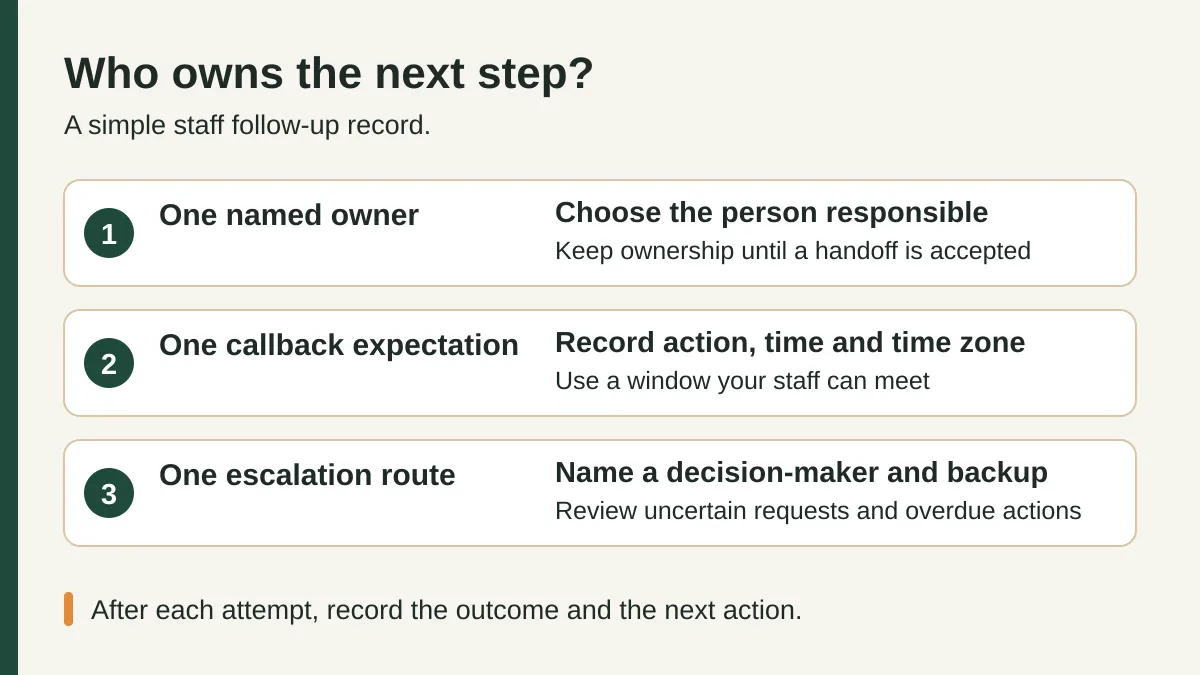
A lead follow-up checklist should give every open inquiry one named staff owner, a callback expectation and a route for uncertain requests. For Utah guides, outfitters and rental shops, capture the next action alongside the inquiry—not just a phone number. Keep ownership with that person until another staff member accepts the handoff, and record what happens after each contact attempt.
What belongs on a lead follow-up checklist?
A lead is a person asking about a possible trip or rental; receiving the inquiry does not mean the business has a booking. A useful follow-up record shows who will act, when they will act and what decision remains open. The checklist below can live in your existing staff queue or booking workflow.
- ☐ Record when the inquiry arrived and which channel it came through.
- ☐ Record the caller's name, preferred callback contact and requested contact method.
- ☐ Summarize the trip or rental, requested date, party size where relevant and the question to resolve.
- ☐ Assign one named staff owner, plus a backup for that shift.
- ☐ Write the next action: check inventory, obtain a custom quote or call to clarify the request.
- ☐ Record the callback window communicated to the caller, including the time zone.
- ☐ Flag anything requiring a manager or qualified staff decision.
- ☐ Record each contact attempt, its outcome and the next action.
- ☐ Close the record with a meaningful status: confirmed, declined, awaiting caller or unable to reach after the team's agreed attempts.
Collect only details needed to handle the inquiry. Keep notes in a staff-only system with access limited to the people who need them, rather than an open spreadsheet or a personal message thread. Avoid payment-card details and sensitive personal information in general lead notes.
Name a person, not a department
“The front desk will handle it” leaves the action open. “Taylor will check the group request and call by 11:00 a.m. Mountain Time” gives the team something to review.
The owner is accountable for the next step, not necessarily qualified to answer every question. That person can ask a manager to decide an exception while retaining responsibility for updating the caller.
If Taylor's shift ends, Jordan must accept the handoff. Sending Jordan a notification is not the same as Jordan taking ownership. Until the transfer is accepted, Taylor or the designated shift supervisor needs to keep the request visible.
Set a callback expectation your team can meet
Choose response windows from your staffed schedule. Don't copy an aggressive sales-response target if it would require guides to stop serving guests. Prioritize inquiries by the decision time and staff availability, rather than assuming every new lead has the same deadline.
A callback message might say:
“Taylor will call between 10:00 and 11:00 a.m. Mountain Time tomorrow after checking the group request. If we need more time for the quote, Taylor will update you during that window.”
Add that window to the record. If the owner cannot meet it, the backup should review the inquiry and update the caller before the window ends. If the caller doesn't answer, record the attempt and follow the caller's contact preference; don't turn an inquiry into an unrelated marketing sequence.
Escalate uncertainty without losing the callback
Use a named decision-maker for requests outside the approved information. Common examples include a custom itinerary, a large-group arrangement, a policy exception or a question requiring qualified staff judgment.
Record three things: the unresolved question, who can decide it and when the owner will check for an answer. An “urgent” label alone does not tell anyone what to do.
Also define what happens when a callback is overdue. A shift supervisor can review the queue at agreed points, reassign an unavailable owner and make sure the caller receives an update. Choose those review points around your operations; they are a staff practice, not evidence of any particular response rate.
Walk through a custom-group inquiry
Consider a fictional guiding business near Ogden. On Monday, a caller asks about a private trip for ten people on Saturday, outside the standard booking options.
| Record field | Worked example |
|---|---|
| Owner and backup | Taylor owns the inquiry; Jordan covers if Taylor is unavailable |
| Open decision | Whether staff can offer the requested custom trip |
| Next action | Taylor asks Casey, the trip manager, to review the request |
| Caller expectation | Taylor will call Tuesday, 10:00–11:00 a.m. Mountain Time |
| Escalation | If Casey's answer is missing at 10:00, Taylor asks the shift supervisor for review |
| Outcome | Record the decision or update, then any agreed next step |
If Casey needs more information, Taylor calls within the promised window to ask for it. If Jordan takes over, Jordan accepts the record before Taylor leaves. Neither staff member describes the trip as confirmed while the decision remains open.
For what to tell a caller before staff review, see the after-hours inquiry and booking-state plan. For how requests reach the queue while guides are busy, see the outfitter missed-call plan.
Check ownership at the next shift handover
Ask the incoming staff member to identify who owns each open inquiry and what happens next. If that requires searching messages or guessing, put ownership and completion status in the shared staff queue. The “name the callback person” recommendation in our fictional Utah rental-shop sample audit gives a short shift note you can adapt; its owner questions help you choose a workable backup and review schedule.
For manual actions matched to your current call ownership and follow-up, use the browser-only missed-call self-check before the next shift change; your choices stay on that page.
Use the printable callback handover sheet at your next shift change to agree on staff roles, backups and review times. Start with the blank sheet or follow the fictional rental example; keep customer contact details in your approved staff-only queue.
For a review of where your follow-up loses a clear owner, Request a Free Missed-Call Revenue Audit from Growth Ops Agency. Share how staff assign, hand over and close inquiries—not customer records. The review does not calculate recovered revenue or activate automated callbacks, texts or follow-up sequences; any automation requires an expressly agreed setup.